



Steel Structure vs Concrete is one of the most important early decisions in any British Columbia building project. The more cost-effective option is not always the one with the lower material price, because labour, construction speed, seismic requirements, foundation loads, site conditions, and long-term maintenance all affect the final value. For commercial, industrial, agricultural, and custom building projects across BC, understanding where steel and concrete perform best can help owners, developers, and contractors avoid costly assumptions. At Apex Metalwork, we work with clients who need practical, durable, and efficient steel solutions, so this guide breaks down the key differences in a clear way to help you make a more informed structural choice.
Quick Answer: Is Steel Structure vs Concrete More Cost-Effective in BC?
In many BC projects, the Steel Structure vs Concrete comparison often shows that steel is more cost-effective overall, especially for warehouses, industrial buildings, farm structures, and commercial spaces that benefit from faster construction, lighter foundations, and flexible clear-span layouts. Even when material pricing shifts, steel can reduce total project costs through shorter schedules and lower on-site labour demands.
That said, concrete can be the better-value option for certain building types, including parkades, podiums, retaining structures, and some multi-storey residential projects where mass, fire resistance, or structural form make it more practical. In British Columbia, the most cost-effective choice depends on the building’s use, site conditions, seismic requirements, and total installed cost, not just the upfront material price.
For a deeper breakdown of pricing factors, you can also read our guide on how much a steel structure costs.
Steel Structure Advantages for BC Projects
For many commercial, industrial, and agricultural projects in British Columbia, steel offers practical advantages that become clear in any Steel Structure vs Concrete comparison. It can help reduce build time, create more usable interior space, improve seismic resilience, and make future modifications easier. These benefits are especially important in BC, where labour costs, land value, permitting pressure, and seismic design all influence total project cost.
Faster Erection and Shorter Project Timelines
One of steel’s biggest advantages is speed. Most structural steel components are fabricated off-site, then delivered ready for installation. That reduces the amount of on-site forming, curing, and sequencing required compared with concrete construction.
In BC, shorter erection time can improve cost-effectiveness in several ways:
- Lower on-site labour demandFewer site-intensive structural steps often mean better labour efficiency.
- Less weather exposureFaster enclosure helps reduce delays during wet or cold periods.
- Earlier occupancy or operationsOwners may begin using the building sooner, which can improve project return.
- Better coordination with other tradesA predictable steel frame often helps mechanical, electrical, and envelope work start sooner.
Long Spans and Flexible Interior Layouts
Steel is often preferred when a project needs open space without too many interior columns. This is common in:
| Building Type | Why Steel Works Well |
|---|---|
| Warehouses | Maximizes storage and forklift movement |
| Equipment shops | Creates clear work areas for vehicles and machinery |
| Agricultural buildings | Allows open planning for livestock, feed, or storage |
| Commercial units | Supports adaptable tenant layouts |
Strong Seismic Performance Through Ductility
British Columbia’s seismic design requirements make structural behaviour a major part of cost and risk planning. Steel performs well in seismic zones because it is ductile, meaning it can deform and absorb energy without failing in a brittle way.
For BC projects, that can translate into:
- reliable structural performance under lateral movement
- efficient detailing for seismic force resistance
- reduced concern over excessive structural weight compared with heavier systems
- a strong fit for many industrial and commercial building applications
Seismic design still depends on the exact system, geometry, and engineering approach, but steel is widely valued for how it responds under earthquake loading.
Easier Expansion, Retrofit, and Adaptive Reuse
Buildings rarely stay unchanged for their full lifespan. A warehouse may expand, a farm building may need new openings, or a commercial property may be converted for a different tenant. In these situations, steel often gives owners more flexibility.
Because steel systems are typically easier to modify, they can be a strong choice for projects that may evolve over time. Common advantages include easier connections for additions, more straightforward reinforcement strategies, and less disruption when adapting the structure for new uses. For owners thinking beyond initial construction, that flexibility can become a meaningful long-term cost benefit.
Concrete Structure Advantages for BC Projects
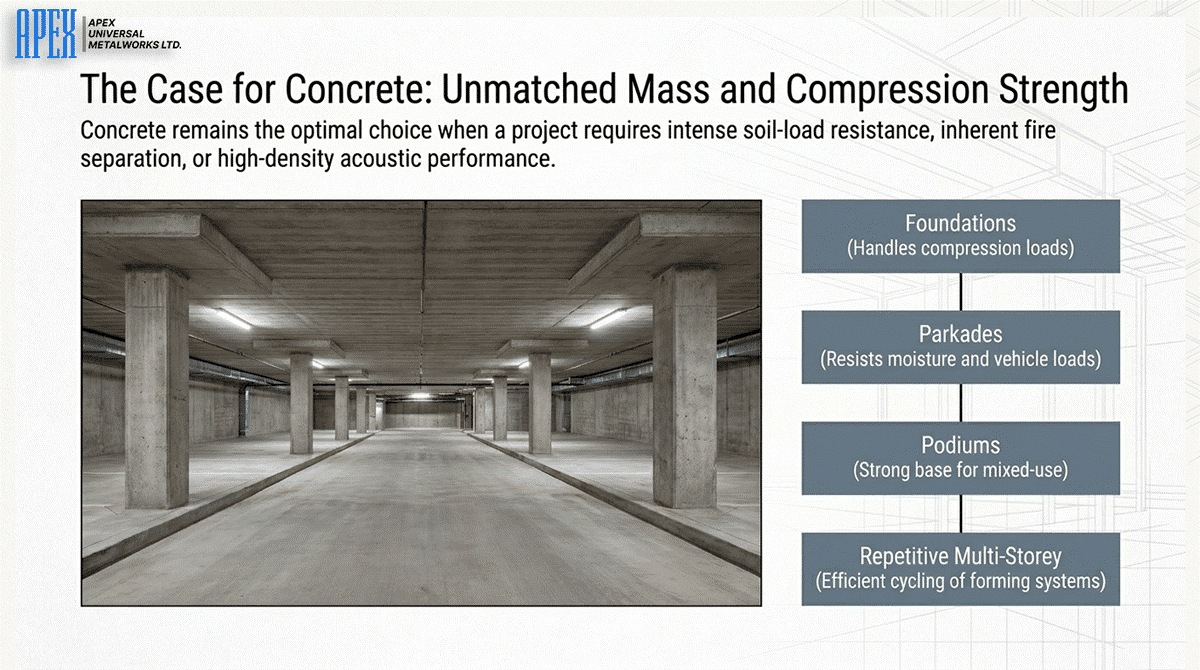
Concrete remains a strong option in the Steel Structure vs Concrete decision for many British Columbia projects, especially where weight, rigidity, fire resistance, acoustic separation, or below-grade performance are major priorities. While it is not always the fastest system to build, concrete can be highly cost-effective when the building’s function matches the material’s strengths.
Fire Resistance and Mass
Concrete has strong inherent fire resistance because it is non-combustible and does not lose strength as quickly under heat as some exposed structural materials. This can make it valuable in buildings where fire separation, durability, and code compliance are major design factors.
Its mass can also be an advantage in certain projects. Heavier structural elements may help with stability, vibration control, and impact resistance, particularly in parkades, podium structures, and buildings with demanding occupancy requirements.
Acoustic and Thermal Performance
Concrete can perform well where sound control and thermal stability matter. Its density helps reduce noise transfer, while its thermal mass can help moderate indoor temperature swings when properly integrated into the building design.
Key benefits include:
- Better sound separation between floors or units
- Reduced vibration in some occupied spaces
- Thermal mass that can support energy performance strategies
- Solid feel that is often preferred in residential and mixed-use buildings
These advantages are especially relevant in multi-family, commercial, and institutional projects where occupant comfort is a priority.
Strength for Foundations, Parkades, and Below-Grade Structures
Concrete is often the preferred material for structural elements that are in contact with the ground or must resist heavy loads, moisture, and lateral pressure.
| Application | Why Concrete Is Commonly Used |
|---|---|
| Foundations | Handles compression loads effectively |
| Parkades | Suits ramps, slabs, columns, and fire-rated assemblies |
| Basements | Performs well in below-grade conditions |
| Retaining walls | Resists soil pressure and site grade changes |
| Podiums | Provides a strong base for mixed-use or residential buildings |
Suitability for Repetitive Multi-Storey Layouts
Concrete can become more economical when a building uses repeated floor plans, repeated column grids, and consistent wall or slab layouts. This is why it is common in many multi-storey residential, hotel, and mixed-use projects.
Once forming systems, crews, and sequencing are established, repetition can improve efficiency. In these cases, concrete’s slower start may be balanced by predictable construction cycles and strong long-term performance. For projects with stacked layouts and high fire or acoustic demands, concrete can be a cost-effective structural solution.
Steel Structure vs Concrete Cost Comparison Table
The table below gives a practical Steel Structure vs Concrete comparison from a total project cost perspective. Actual pricing in BC will vary by location, design complexity, labour availability, seismic requirements, and market conditions.
| Cost Factor | Steel Structure | Concrete Structure |
|---|---|---|
| Material cost | Can fluctuate with steel market pricing, but efficient design can offset this | Often competitive for high-volume or repetitive work |
| Construction speed | Usually faster due to off-site fabrication and quick erection | Typically slower because of forming, pouring, curing, and sequencing |
| Labour requirements | Often lower on site, with more work completed in fabrication shops | More site-intensive, especially for cast-in-place systems |
| Foundation cost | May reduce foundation demands because steel is lighter | Heavier structure can increase foundation requirements |
| Seismic design impact | Strong ductility can be beneficial in BC seismic zones | Can perform well, but added weight may increase seismic forces |
| Long-span capability | Excellent for open layouts, warehouses, shops, and industrial buildings | May require deeper members or more columns for similar spans |
| Fire protection cost | May need coatings, encasement, or rated assemblies depending on code requirements | Naturally fire-resistant in many applications |
| Acoustic performance | Requires additional assemblies for sound control | Strong acoustic separation due to mass |
| Future expansion | Usually easier to modify, expand, or retrofit | Can be more difficult and disruptive to alter |
| Best value use cases | Industrial buildings, warehouses, agricultural structures, commercial shells, equipment shops | Parkades, foundations, podiums, below-grade structures, repetitive multi-storey buildings |
In general, the Steel Structure vs Concrete comparison tends to favour steel when speed, open space, lighter foundations, and future flexibility matter most. Concrete often has the cost advantage when mass, fire resistance, below-grade performance, or repeated multi-storey layouts are central to the design.
When Steel Is Usually More Cost-Effective
Steel is often the better-value option when a project benefits from speed, open space, lighter structural weight, and easier future modifications. In BC, that usually makes it a strong choice for the following building types and delivery conditions.
Industrial and Warehouse Buildings
For warehouses, fabrication spaces, logistics buildings, and equipment shops, steel is commonly the more economical system because it supports long spans, efficient erection, and flexible interior use. Fewer interior columns can also improve storage layout and vehicle movement.
For projects that need more usable interior space, metal mezzanines can also be an efficient way to expand functionality without a full building addition.
Commercial and Retail Projects
Many commercial shells, retail units, and service buildings use steel because it allows faster construction and simpler tenant fit-outs. When schedule matters, steel can help owners open sooner and reduce some site-driven costs.
Long-Span or Open-Concept Buildings
Steel is especially cost-effective in buildings that need wide, unobstructed interior areas, such as:
- agricultural buildings
- recreation facilities
- showrooms
- workshops
- loading and service areas
In these cases, steel often delivers better functional value than heavier systems with tighter spacing needs.
Fast-Track Construction Projects
If the project timeline is tight, steel usually has a clear advantage. Off-site fabrication and faster erection can shorten the path to enclosure and occupancy, which is often a major cost benefit in BC.
Building Additions and Future Expansions
Steel is also a smart choice when a building may need to grow over time. It is generally easier to connect additions, create new openings, or modify structural layouts without the same level of disruption that heavier systems can involve.
When Concrete Is Usually More Cost-Effective
Concrete often becomes the better-value choice when the project needs mass, below-grade strength, fire resistance, or strong acoustic performance. In BC, that usually applies to structures where concrete’s physical properties align closely with the building’s main function.
Underground Parking and Below-Grade Structures
Concrete is commonly the most practical option for parkades, basements, and other below-grade elements because it handles soil pressure, moisture exposure, and heavy loads well. It is also well suited to ramps, slabs, and retaining conditions.
High-Rise Residential and Mixed-Use Towers
For taller buildings with repetitive floor plates, concrete can be cost-effective because the formwork systems and repeated layouts support efficient construction. It is also widely used where fire separation and sound control are important.
Foundations and Retaining Walls
Concrete is often the standard choice for foundations and retaining walls because it performs well under compression and lateral pressure. For many BC sites, especially those with slopes or challenging soil conditions, this makes concrete the most practical structural material.
Projects Requiring Mass, Fire Resistance, or Acoustic Separation
Concrete is usually a strong fit when the project needs:
- inherent fire resistance
- better sound isolation between spaces
- thermal mass for energy performance
- vibration control
- a solid, heavy structural base
That makes it especially useful in residential, institutional, and mixed-use buildings where comfort and code performance are key priorities.
Hybrid Steel-Concrete Structures: Often the Best of Both
For many BC projects, the best value comes from using steel and concrete together. A hybrid system can reduce cost, improve speed, and use each material where it performs best.
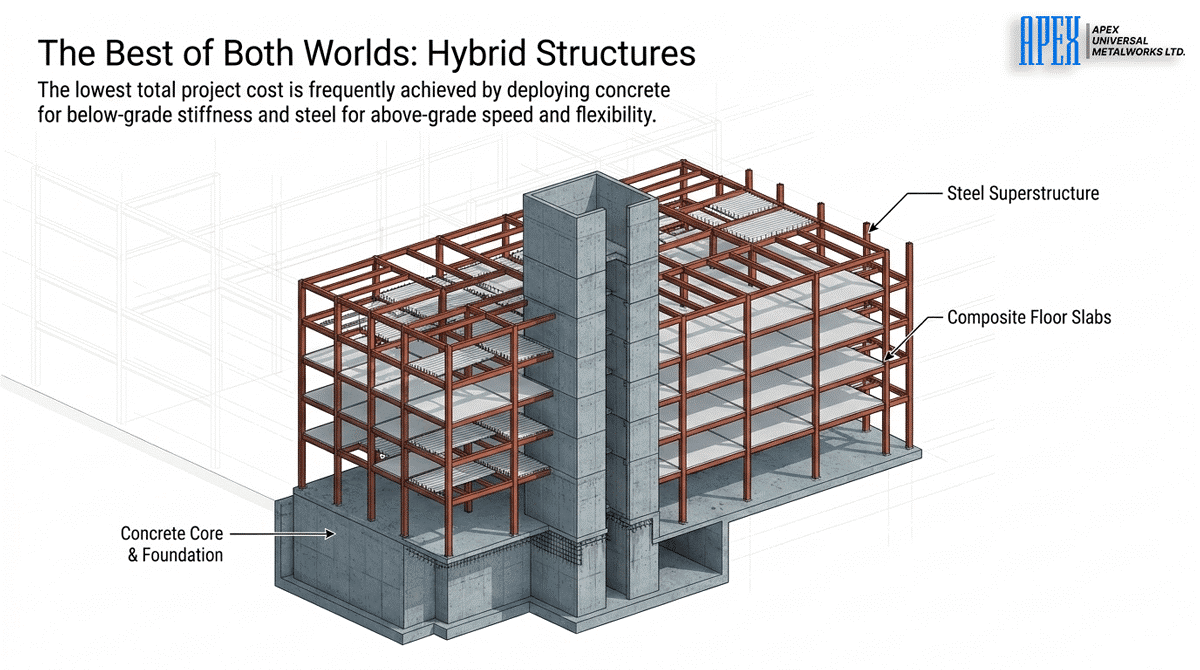
Concrete Foundations with Steel Superstructures
Concrete is often used for footings, foundations, and below-grade work, while steel is used for the above-grade frame. This gives the project a strong base with faster erection and more flexible building space.
Composite Steel Beams and Concrete Slabs
Steel beams and concrete slabs can work together to improve span, strength, and floor performance. This approach is useful when a project needs both efficient framing and solid floor construction.
Concrete Cores with Steel Framing
In some multi-storey buildings, concrete cores provide stiffness around stairs and elevators, while steel framing creates faster, more adaptable floor areas. This can offer a practical balance of strength, speed, and layout flexibility.
BC Project Examples: How the Best Choice Changes by Building
The best choice changes by project type.
- Industrial Warehouse in Surrey
- Usually steel for speed and open space.
- Commercial Building in Burnaby or Richmond
- Often steel or hybrid, depending on layout and parking needs.
- Underground Parkade in Vancouver
- Usually concrete because it suits below-grade construction.
- Agricultural or Light Industrial Building in the Fraser Valley
Steel often works best:
- quick to build
- good for clear spans
- easier to expand
If you are planning a commercial, industrial, or agricultural project, working with an experienced team in steel structure construction in BC can help you evaluate the most cost-effective system from the start.
Seismic Performance: Steel vs. Concrete in British Columbia
In BC, both sides of the Steel Structure vs Concrete comparison can be designed for strong seismic performance. The difference is in how each system responds and how well it is detailed.
Why Ductility Matters in Seismic Design
Steel is often preferred for its ductility. It can bend and absorb earthquake energy without sudden failure. Concrete can also perform well, but it relies more heavily on reinforcement and confinement detailing.
The Role of Structural Engineering and Detailing
Seismic performance depends on more than material choice. It also depends on:
- connection design
- reinforcement detailing
- lateral load path
- workmanship and construction quality
Choosing a System Based on Building Type and Risk Profile
| Project Factor | Better Fit May Be |
|---|---|
| Long-span industrial or commercial space | Steel |
| Heavier below-grade or mass-based structure | Concrete |
| Mixed project needs | Hybrid system |
In BC, the safest and most cost-effective choice comes from matching the structural system to the building type and seismic demands.
Common Mistakes When Comparing Steel and Concrete Costs
Many Steel Structure vs Concrete cost comparisons go wrong because they focus on one line item instead of the full project picture.
Comparing Material Price Instead of Installed Cost
Raw material price alone does not show true value. Labour, fabrication, equipment, and erection or forming costs all matter.
Ignoring Schedule and Financing Costs
A faster structure can reduce site overhead, shorten the construction timeline, and help the project reach occupancy sooner.
Forgetting Fireproofing or Coating Requirements
Steel may require fire protection or corrosion coatings, while concrete may need added work for finishing, waterproofing, or repairs. These costs should be included early.
Underestimating Foundation Costs
Heavier structural systems can increase foundation demands. On some BC sites, that can make a major difference in total cost.
Not Considering Future Expansion or Modifications
A lower initial cost may not be the best long-term value if the building will need additions, layout changes, or retrofits later.
Overlooking BC Weather and Site Access Challenges
Rain, tight urban sites, and difficult access can affect labour, sequencing, and installation methods. In BC, these practical factors often change the real cost comparison.
Conclusion
In BC, the Steel Structure vs Concrete decision often comes down to whether the project benefits more from speed, lighter weight, and flexibility, or from below-grade strength, mass, and fire resistance. If you need a reliable steel solution built for BC conditions, Apex Metalwork can help with practical, durable, and efficient structural steel fabrication.